
A Black Cat Gave Me My Attention Back
How adopting a cat altered my relationship with attention, burnout, and being seen.

Caped Corners: personal essays about attention, belonging, and building continuity in a distracted life (through books, faith, loneliness, and the small rituals that keep us human).
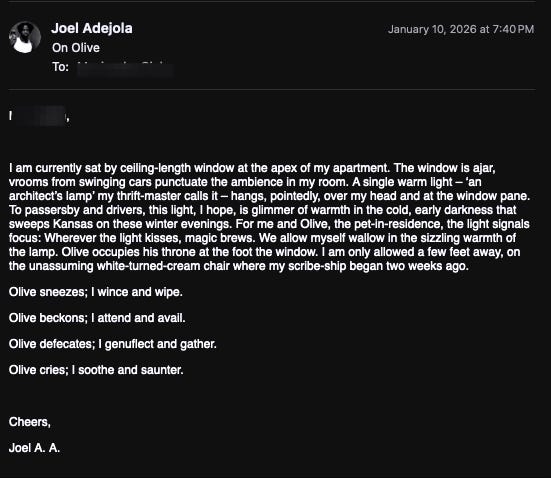
I am currently sat by the ceiling-length window at the corner of my apartment.
The glass is slightly ajar. Vrooms from passing cars punctuate the cold, early darkness that sweeps Kansas on winter evenings. A single warm light – “an architect’s lamp,” my thrift-master calls it – hangs over my head and pierces the window pane.
To passersby, I hope this light is a small glimmer of warmth. For Olive and me, it’s a signal: wherever the light lands, that’s where focus lives.
Olive occupies his throne at the foot of the window. I’m allowed a few feet away, on the unassuming white-turned-cream chair where my scribe-ship began again several weeks ago.
We establish a rhythm now:
Olive sneezes; I wince and wipe.
Olive beckons; I attend and avail.
Olive defecates; I genuflect and gather.
Olive cries; I soothe and saunter.
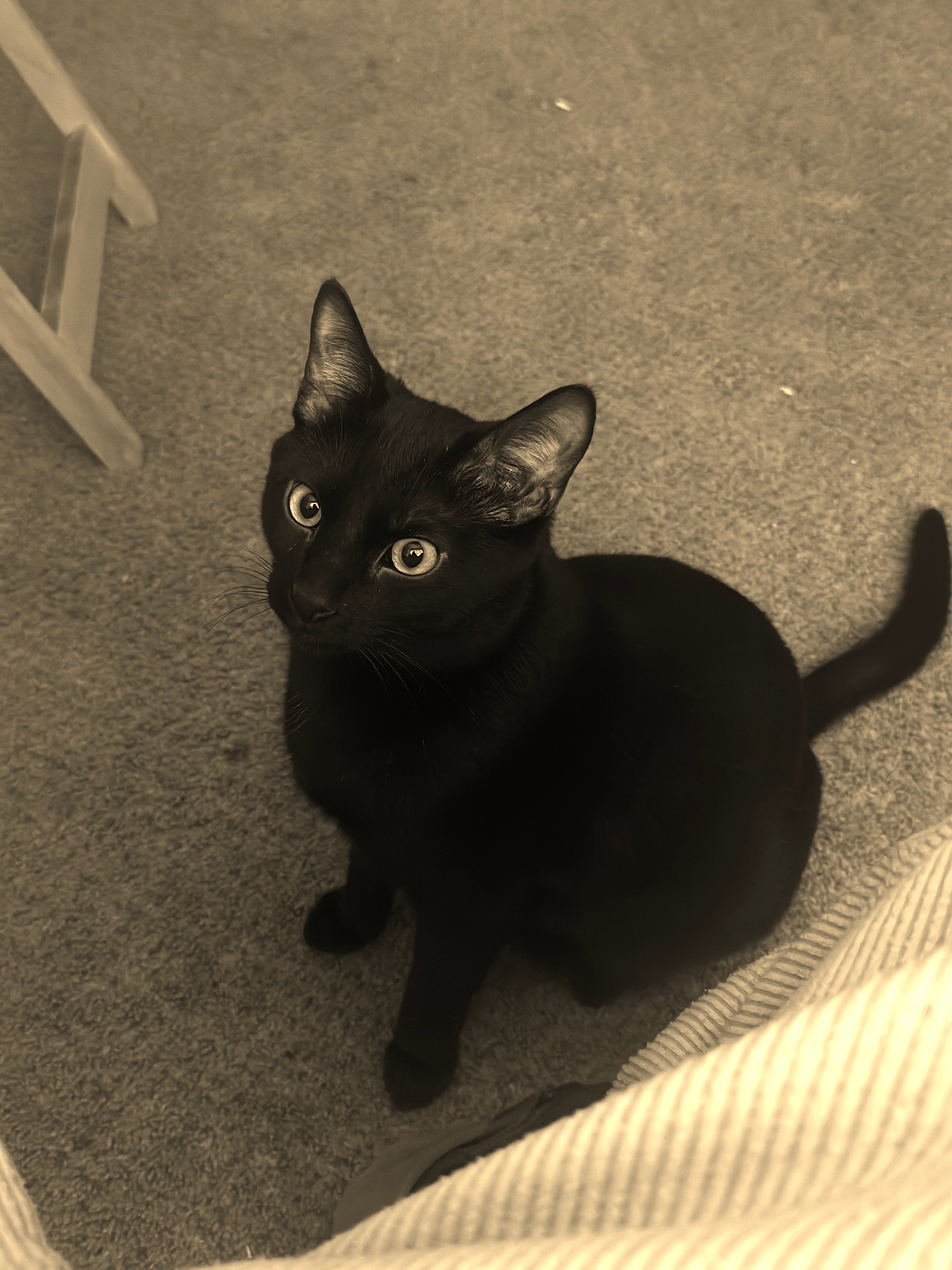
Four weeks have passed since Olive (née Mason) – my cat-neighbor – moved into my life. In that time, I have started and finished four books, started writing letters to my friends again, sold my PlayStation, and found a renewed access to the divine and the sublime.
I’ve also been writing this essay since.
This is an attempt to capture the oddly stabilizing experience that has followed our adoption. If your disposition towards cats changes, even slightly, by the end of this, I’d like to hear about it.
Why did I decide to get a pet?
In the parts of Nigeria I knew best, stray cats didn’t exist.
Not a single one.
It felt like if you spotted one, you were the last person to see it alive. You might see a stray dog with a collar or a strip of ankara fabric knotted round its neck. You’ll certainly see goats during Eid al-Adha (Sallah). But never a stray cat. Especially not a black one.
We didn’t “do” cats like that.
So what led me, a Nigerian who grew up with stories of cats-being-witches, to my town’s humane society to adopt a cat – and then pick the black one?
It’s simple, actually: I was lonely.
Not lonely in the “I have no humans in my life” sense. I have friends. I have people. I can call home. We speak. We joke. There is love. It was a different kind of loneliness. The needing-to-be-seen kind. The third-culture-kid, nothing-quite-lands kind. The “I am surrounded by people and yet none of these contexts truly know the full continuity of me” kind.
Time, the shallow but relentless pressures of our increasingly connected world, and the burdens of being somewhere that’s not yet home had etched an existential-sized hole in my chest.
I felt alone – despite sitting in seminar rooms with classmates, living with mates at my scholarship program, bantering with digital avatars online.
I felt unheard – despite calling home every day and giving the usual “school is fine, classes are fine” updates.
I felt weak – despite riding the high of my latest publication or crushing an outdoor workout that morning.
What I longed for was something quieter: some reliable hinge to direct my love and joy and craft toward. Something that didn’t need me to explain my backstory before accepting my presence. Something that would still be there when all the Zoom calls ended and the lights in the classroom went off.
After almost eight years of communal living in Nigerian and South African boarding schools, I had become very capable of creating and offering love. I’m good at being That Person in a shared space: the one who shows up, initiates, holds things together.
I’m less good at dealing with the way the wider world often… doesn’t.
A letter from a beggar
At some point, the loneliness broke the surface and forced itself into words.
I had a choice. There is always a choice: sit and wallow some more, or risk the small humiliation of being earnest and tell my people how I was actually doing.
So I wrote a letter titled “A Beggar Writing to Their Friend.”
My dear friend,
My laptop says it’s 14:35, but time is actually 23:00. I am tucked underneath my navy comforter, two feet and back-of-head making a three-point hold against my bed. It is cold fucking day is Lawrence, Kansas. But for the first time in many months, I felt an enduring glimmer of hope. History tells me that this spontaneous piece will result in tears.
It’s difficult to pick a starting point. Shall I talk about the extent of my most immediate despair: how I’ve longed to see your face; to feel your warmth again; to be able to wake up and see you at the day’s break. Or shall I talk about the hopes we once shared that I’ve buried. Do the stars still smile when they see your face?
It’s that time of the year again. November. When, for the past few hours, I’ve made my yearly pledge to start anew, to chase epiphanies, and to become. This year’s different. (And, if you’ve read my newsletter, you know I say that often.)
This next year – tomorrow even– I just want to be happy. I want to call you whenever our heart settle and our minds beckon the other. I want to read your kind, most passionate words. I want to love the small corners of the world with you. I want to laugh and cry about your quirks, notice your sighs, when your breathing changes, and cherish the moment.
I want to hear and read about the mundane things – who or what is the latest lover, which insect woke you up at night, what you ate in the morning, what you’re reading soon.
With so much love,
Yours in arms,
Gingerly,
Joel A. A.
Nov. 8th, 2025
I sent this to nine people.
Three replied. One of them, with an emoji.
This is not an indictment of anyone. People are busy. People are overwhelmed. People have their own November crises. But the silence confirmed what my body already knew: I needed something in my life that did not depend on other people’s schedules to exist.
I needed continuity.

They told me not to get a pet
When I started floating the idea of adopting a cat to friends (the ones who did pick up), the response was almost uniform:
“It’s a lot of work.”
“Why would you burden yourself?”
“Who will take care of it when you travel?”
“Are you sure you want that responsibility?”
All fair questions. But I kept thinking:
We already carry so much “responsibility” every day: dissociating for hours on TikTok or YouTube, consuming whatever the news cycle throws at us, tracking the micro-dramas of people we’ll never meet, doomscrolling our way through global crisis after crisis.
We happily offer our attention—our life—for free to corporations and platforms. But the idea of being responsible for a creature that lives with us, looks us in the eye, and purrs when we come home? That’s the scary part?
Why is the burden of a companion more frightening than the burden of our glowing rectangles? Why have we been conditioned to avoid the kinds of attachment that might actually anchor us, and seek instead the safe, predictable, algorithmically curated ones?
I decided not to poll my family about it. I could already hear the worry in their voices: black cat, alone in a foreign country, are you alright?
So I let the idea stew silently.
Meeting Olive for the First Time
On my second visit to the humane society in town, the staff told me I could adopt as soon as I was ready.
I wasn’t.
If anything, I was in one of the more miserable stretches of that month — lots of emotional static, not much signal. But I went anyway. I told myself I was just “visiting.”
Olive was the most boisterous cat in the pen.
He paced. He meowed. He poked his paw through the slender bars of the black cage. His coat was a dark, shiny black with a grey under-layer that revealed itself when the light hit. His eyes were piercing, greenish, alert. He walked and pranced with a kind of contained chaos I recognized.
I asked one of the caretakers to open his cage. I had a small rule for myself: I would not chase affection. I would squat, stretch out my hand, and see who came.
The first cat we met retreated immediately to the back of their cage and stayed there, still. That was my answer.
When we opened Olive’s, he was all over me. He climbed out eagerly, rubbed himself against my hand, my leg, my jeans. The caretaker had to gently temper his enthusiasm so I wouldn’t leave with claw marks.
Our connection felt right in a way that bypassed language. So I signed the papers.
A friend later asked me: “How does a cat know it has a new owner? Are they just open to anyone who feeds them?”
From what I’ve been told, they respond to whoever gives them care and safety. To initiate this transition, the shelter staff volunteer to do the unpleasant parts, putting them into a crate or box – so the new owner gets to be the one who “rescues” them into the new space.
Food, shelter, eye contact. I remembered reading that calm attention can be bonding – oxytocin, safety cues, whatever the mechanism is – so when I brought Olive home, I spent the first 90 minutes sitting still on a chair, just watching him explore.
At some point, I went to lie on my bed. He padded over and curled up against my side, as if to say, “Alright then. This is the new thing.”
What cats teach you (if you let them)
Since Olive moved in, I’ve started to notice a few things.
Not about cats in general — there are probably websites for that — but about what this one cat has been to me.
I’ll name a few.
1. Olive as a mirror
Olive is unnervingly responsive to my internal state.
When I’m calm, reading, or deep in flow — writing or on a focused call — he curls up behind me, or on the chair next to me, and sleeps. When a friend visits and we’re locked in conversation, he’s content to laze nearby.
But when I come home scattered, flustered, phone in hand, jumping between apps, pace aimlessly from bed to desk and back? He intercepts.
He meows. He walks across the keyboard. He plants himself on my chest. He stares.
It’s as if he can’t bear watching me erode my own attention like that.
I’ve started to treat him like a living notification: if Olive is restless around me, I probably am too.
2. Olive the Cuddler-in-Chief
Before getting a cat, I had that vague internet-driven idea that “cats are aloof” and hate being touched.
This is not true for all cats. It is certainly not true for mine.
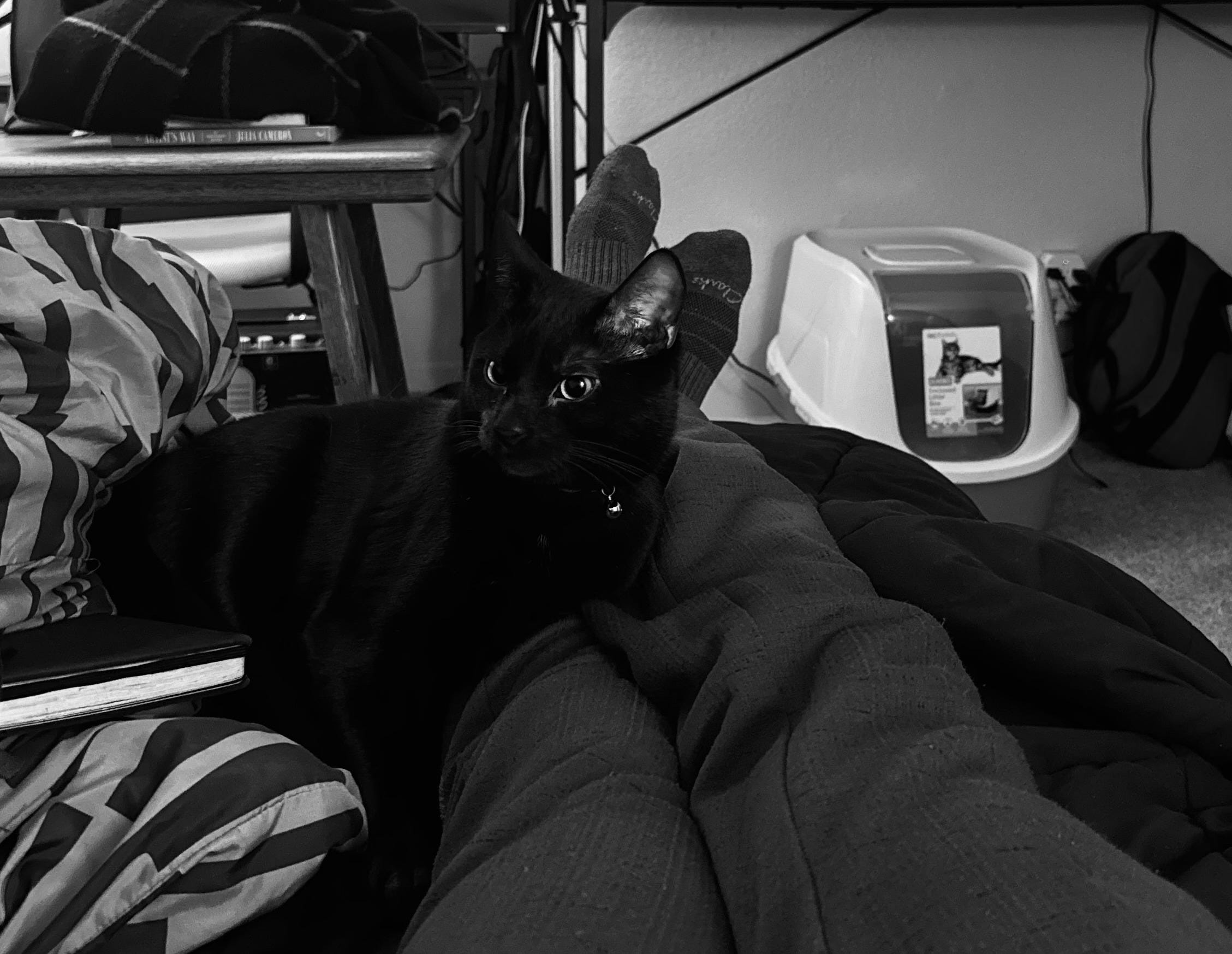
At night, Olive rotates through multiple positions around and on me. Sometimes he sleeps at my feet. Sometimes behind my knees. Sometimes pressed against my side or chest. The only constant is that he insists on contact: at least one paw, one whisker, one part of him touching one part of me.
It’s a small, steady reminder: you are not alone in this room.
There is a softness in having another heartbeat near you that doesn’t demand conversation, performance, or explanation.
3. Olive the clean-freak
Cats get stereotyped as mysterious and moody, but one of the funniest things about living with Olive is how fastidious he is.
The amount of time he spends grooming himself, adjusting his fur, curling and uncurling his paws — it’s almost ritualistic. He also expects this standard from his surroundings.
If I slack on tending to the litter box, he lets me know with a subtle avoidance or meow that clearly communicates: You are slipping, my guy. Fix it.
There’s an accountability here that doesn’t feel punitive. It’s more like: “You chose this. Show up to it.”
On continuity and care
I used to think of burnout as a dramatic crash: everything stops, you lie in bed for days, you dissociate, and you drop all your responsibilities.
That version exists, but the one I’m more familiar with is quieter: the slow erosion of continuity.
You stop reading the books you bought.
You postpone the messages you meant to send.
You show up to your commitments physically but not fully.
You pour out more of yourself than you are finding ways to refill.
Getting a cat didn’t “fix” my burnout. But it introduced a small, daily continuity that is surprisingly non-negotiable.
It’s simple. No matter how my day goes:
Olive will need food.
Olive will need a clean place to poop.
Olive will want to sit by the window when I write.
Olive will climb into bed with me at night.
There is a baseline of care I cannot outsource or postpone indefinitely. And that baseline has become a kind of metronome for my life.
Instead of floating through days, I have anchor points. Instead of only interacting with the world through screens, I interact with a very real, very embodied creature who does not care what my essay stats were that week.
He cares that I am here.
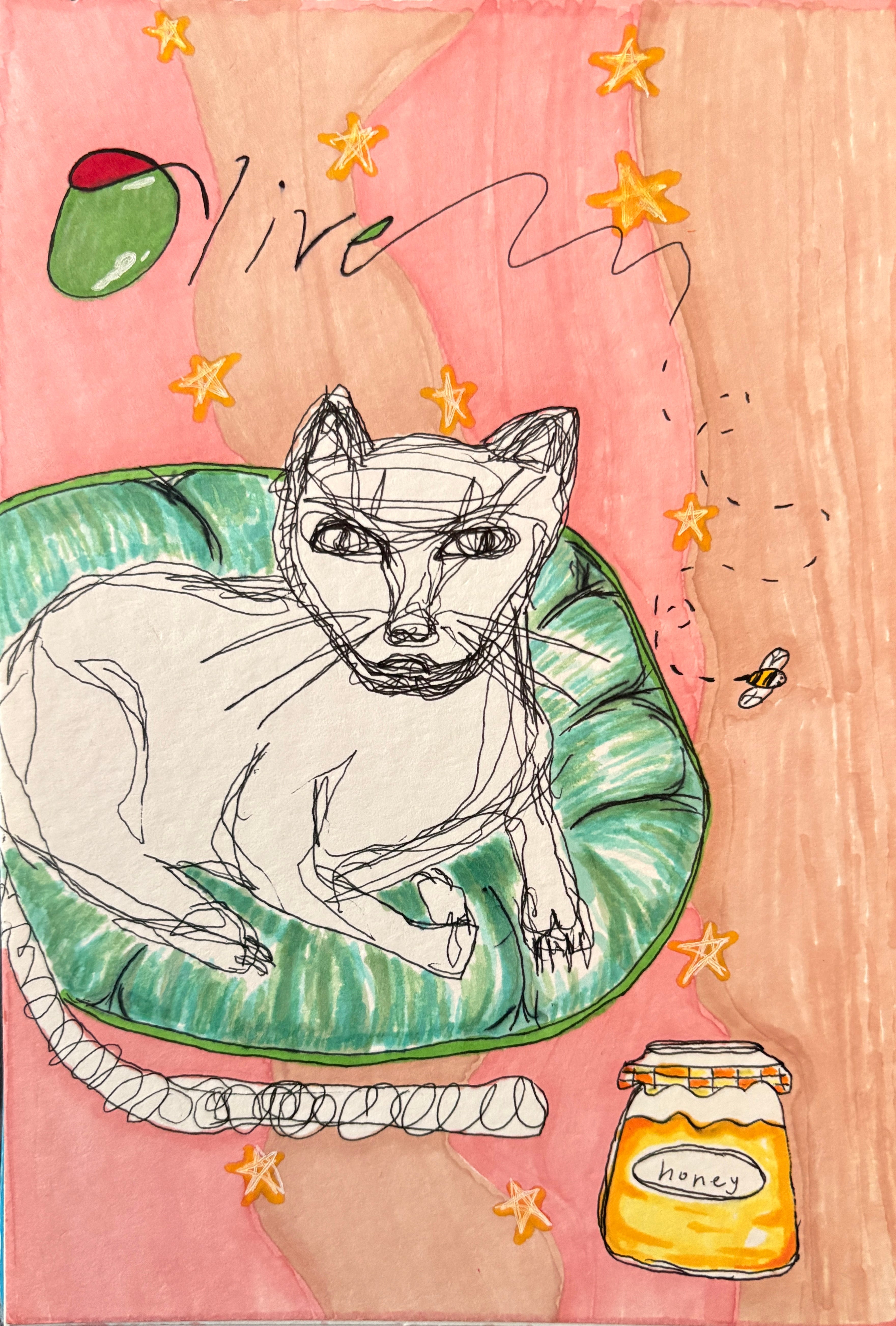
So…should you get a cat?
For some people, the answer is: not now. Pets are a lot of work. They are a real responsibility. They can complicate travel. They can strain finances. In some seasons, it might not be wise.
Still, as I echoed in my last essay, I will say this:
If you, like me, have found yourself increasingly alienated from a world that feels hyper-connected but under-attached…
If you’ve been craving some continuity that isn’t contingent on people’s schedules or systems’ failures…
If you’ve caught yourself pouring all your care into institutions, projects, timelines, and platforms that do not love you back…
Then it might be worth asking:
What would it look like to bring one small, living, non-digital point of attachment into your life?
Something, someone, or even a community you are allowed to care for daily, one that quietly cares back.
Something that makes you get up, clean, feed, and sit still long enough to be seen by another pair of eyes.
For me, that entity was a black cat called Olive.
Since he moved in, I’ve been reading more. Writing more. Praying more almost, though not always with words. Paying better attention to how I move through my days.
This essay started as “cat content” and veered, as my writing often does, into other corners: loneliness, letters, third-culture-kid tension, continuity, care.
I suppose that’s the real point: Olive is not the solution to my life. He’s a companion in the figuring-out.
And sometimes, that is enough.
PS: I’ve also been reading some excellent books and watching Vince Gilligan’s PLURIBUS since Olive arrived. If you want the next essay on “sit-up TV” (quoting Gilligan) and deep reading, subscribe! In the meantime, reply with your own continuity anchor.
I’d like to partner with an illustrator to add more texture to these essays. If you’re reading this and dabble in fine-arts, kindly reply to this email or leave me a message somewhere.
Thanks to LS, MO, TG, and YK for their contributions to this piece or its writing.
Related essay:
This framing of burnout as the erosion of continuty rather than a dramatic crash is spot on. The idea that Olive functions as a living notificaton when attention starts fragmenting is such a great observation. I've expereinced that same third-culture loneliness where none of the contexts fully see you, and it really does require something outside schedules and timezones to feel real agian.
The slow erosion burnout. God I hate it and love how simply you put it.